The last few years have seen a good amount of focus and research on mobile in libraries and education in general. In the last couple of years social in libraries and education has also been picking up steam.
I'm including a couple of my presentations from 2012 below on these two topics.
What I'm especially excited about of late is Google+ Hangouts, (see slide 24-36 in presentation below). What may be of specific interest to librarians/educators like myself, who work with students and colleagues in ways other than face-to-face, is referenced in slides 29-33. (For those not familiar with Google+ Hangouts, it is arguably the most popular feature of Google+, Google's social networking platform and more.)
Bottom line, in the same way that twitter has become my single most valuable professional development tool over the years, though I was skeptical at first, I'm hopeful that Google+ Hangouts will make certain aspects of my job a little easier. At the same time I hope to be able to provide superior research help to students online using this tool.
Tomorrow I lead a reference tips session at our weekly librarian's meeting on the main campus, which will be all about Hangouts. This Saturday I'll be teaching my second library research class to students in another state via Google+ Hangouts (you can read about my first session here, from back when it was named G+ Hangouts with Extras). A week ago I joined our librarian's meeting on the main campus for the first time from my Portland office with positive results and will continue to attend at least one meeting a month using this tool. There'll be another blog post here soon focused on Google+ and Hangouts with some entertaining screenshots so stay tuned if this topic is of interest.
Are you using Google+ or G+ Hangouts at your library? Are you an educator using Google+ Hangouts for office hours or in any other way? I'd love to hear about what others are doing with mobile and/or social, feel free to share in comments.
I'll end with a quote that resonates with me as I continue to follow mobile and emerging technologies "The most important thing we can do is to ensure that when the technology matures, we are ready to deliver content to it." -Jason Griffey, Head of Library Information Technology at the University of Tennessee and author of Mobile Technologies and Libraries.
Showing posts with label academic librarians. Show all posts
Showing posts with label academic librarians. Show all posts
Thursday, October 18, 2012

Monday, March 7, 2011
Mobile Information Literacy & Mobile Trends
I've attended two of the four Handheld Librarian Conferences (#HHLIB on twitter), and hope to attend many more. This was one of the most relevant conferences I've attended in a while, and one I recommend others consider in the future. It's affordable and as an online conference, accessible to most. (And the archives from years prior are accessible to all.)
I also appreciate that the conference has a good sized international group of attendees/participants. The US is often lagging when it comes to mobile and much can be learned from those outside our country with more experience.
I've embedded the slides here from my Handheld Librarian IV presentation (including links to videos shown during the presentation)
Newer technologies, like those I and others shared, can be fun and useful. However, there were meatier presentations as well, many given by excellent keynote speakers. I discuss one of those presentation below my slides.
There were many valuable sessions during the two day conference, but for me there was one session, a keynote, that stood out - Presented by Andrew Walsh, University of Huddersfield:
"Handheld Information Literacy: Mobilising Existing Models?" Here is a link to the PDF of the presentation.
Research data (cited in the Walsh presentation, my presentation's first video link, and any Google search) confirms that mobile is of huge importance. Many industries are currently hyper-focused on mobile. I don't think most expected the level of exponential growth of mobile we've experienced quite so quickly. Even Google was off with mobile predictions. I know the recent Educause ECAR report on mobile undergraduate use caught me off-guard and I suspect most in higher education are still unaware of those statistics, no less thinking about the teaching and learning implications.
Libraries have been having mobile conversations for a while and many have created mobile sites or mobile library apps. Early adopters within libraries have been implementing simple mobile technologies like QR codes, and soon I expect we'll see more practical and location-based augmented reality used in libraries as well. However, few have begun to think about the larger implications of mobile and it's impact on libraries and educational institutions.
Those attending the Andrew Walsh presentation linked above were challenged to think deeper. The big questions he addressed: "What does all this wonderful technology mean to our users?" and "What does the mobilizing of search and information sources mean to our ideas of information literacy?"
Mr. Walsh presented a brief history of information literacy (IL) including a list of IL attributes fed into standards and models such as the ACRL 2000 standards, the SCONUL 7 Pillars and more. He then compared traditional competency based IL models (fixed IL) to more relational based mobile models and spoke on how mobile IL varies as mobile search can happen anywhere from a range of devices using the mobile web browser or specific apps. Search no longer happens in fixed controlled environments and since people are increasingly attempting to meet their information needs via handheld devices, IL is drastically changed. We need new models to reflect this change. What will it mean to libraries if most information needs are met while on the move?
A lot of food for thought was provided by the Walsh presentation along with Lee Rainie, Director of the Pew Research Center’s Internet & American Life Project, keynote on "The State of Mobile Connectivity" earlier in the day.
More questions than answers are apparent to me at this time, such as: How will mobile change our roles as librarians? What about mobile learning in the classroom and beyond? Will librarians eventually move from being embedded in classrooms and Learning Management Systems to provide more services via twitter and other mobile apps? What other services might we provide? Will librarians, many still expected to fill traditional librarian roles, be free of some of those responsibilities so they can begin to consider the impact of mobile within their organizations and work towards supporting mobile users?
Libraries and librarians are currently working hard to keep up with the digital revolution and the move from print to electronic. The move to mobile is yet another shift, which could further drastically change our traditional roles. How will librarians and libraries keep up and be able to support the needs of our unconnected users as well as our connected and increasingly mobile users? Will we receive the needed buy-in and support from administrators? Or will we be caught off-guard and in outdated librarian roles be seen as no longer relevant?
I've recently begun working on a collaborative research project with two School of Education professors related to mobile learning in K-20 classrooms and beyond. Naturally mobile learning would have a mobile information literacy component. I've been thinking hard about my role as a librarian and relevance, as is the case with many librarians these days. I'm thankful for librarians like Mr. Walsh and others who follow mobile trends from whom I can continue to learn as libraries and librarians help move their institutions into 21st century literacies.
I'm also glad there are IT leaders in higher ed who are focused in this direction as well. My university's CIO, Greg Smith, recently attended the ACU ConnectEd Summit 2011 and shared some thoughts on his blog and in the video below on "The State of Mobile Learning."
I also appreciate that the conference has a good sized international group of attendees/participants. The US is often lagging when it comes to mobile and much can be learned from those outside our country with more experience.
I've embedded the slides here from my Handheld Librarian IV presentation (including links to videos shown during the presentation)
Newer technologies, like those I and others shared, can be fun and useful. However, there were meatier presentations as well, many given by excellent keynote speakers. I discuss one of those presentation below my slides.
There were many valuable sessions during the two day conference, but for me there was one session, a keynote, that stood out - Presented by Andrew Walsh, University of Huddersfield:
"Handheld Information Literacy: Mobilising Existing Models?" Here is a link to the PDF of the presentation.
Research data (cited in the Walsh presentation, my presentation's first video link, and any Google search) confirms that mobile is of huge importance. Many industries are currently hyper-focused on mobile. I don't think most expected the level of exponential growth of mobile we've experienced quite so quickly. Even Google was off with mobile predictions. I know the recent Educause ECAR report on mobile undergraduate use caught me off-guard and I suspect most in higher education are still unaware of those statistics, no less thinking about the teaching and learning implications.
Libraries have been having mobile conversations for a while and many have created mobile sites or mobile library apps. Early adopters within libraries have been implementing simple mobile technologies like QR codes, and soon I expect we'll see more practical and location-based augmented reality used in libraries as well. However, few have begun to think about the larger implications of mobile and it's impact on libraries and educational institutions.
Those attending the Andrew Walsh presentation linked above were challenged to think deeper. The big questions he addressed: "What does all this wonderful technology mean to our users?" and "What does the mobilizing of search and information sources mean to our ideas of information literacy?"
Mr. Walsh presented a brief history of information literacy (IL) including a list of IL attributes fed into standards and models such as the ACRL 2000 standards, the SCONUL 7 Pillars and more. He then compared traditional competency based IL models (fixed IL) to more relational based mobile models and spoke on how mobile IL varies as mobile search can happen anywhere from a range of devices using the mobile web browser or specific apps. Search no longer happens in fixed controlled environments and since people are increasingly attempting to meet their information needs via handheld devices, IL is drastically changed. We need new models to reflect this change. What will it mean to libraries if most information needs are met while on the move?
A lot of food for thought was provided by the Walsh presentation along with Lee Rainie, Director of the Pew Research Center’s Internet & American Life Project, keynote on "The State of Mobile Connectivity" earlier in the day.
More questions than answers are apparent to me at this time, such as: How will mobile change our roles as librarians? What about mobile learning in the classroom and beyond? Will librarians eventually move from being embedded in classrooms and Learning Management Systems to provide more services via twitter and other mobile apps? What other services might we provide? Will librarians, many still expected to fill traditional librarian roles, be free of some of those responsibilities so they can begin to consider the impact of mobile within their organizations and work towards supporting mobile users?
Libraries and librarians are currently working hard to keep up with the digital revolution and the move from print to electronic. The move to mobile is yet another shift, which could further drastically change our traditional roles. How will librarians and libraries keep up and be able to support the needs of our unconnected users as well as our connected and increasingly mobile users? Will we receive the needed buy-in and support from administrators? Or will we be caught off-guard and in outdated librarian roles be seen as no longer relevant?
I've recently begun working on a collaborative research project with two School of Education professors related to mobile learning in K-20 classrooms and beyond. Naturally mobile learning would have a mobile information literacy component. I've been thinking hard about my role as a librarian and relevance, as is the case with many librarians these days. I'm thankful for librarians like Mr. Walsh and others who follow mobile trends from whom I can continue to learn as libraries and librarians help move their institutions into 21st century literacies.
I'm also glad there are IT leaders in higher ed who are focused in this direction as well. My university's CIO, Greg Smith, recently attended the ACU ConnectEd Summit 2011 and shared some thoughts on his blog and in the video below on "The State of Mobile Learning."
Monday, October 25, 2010
Futures Thinking for Academic Librarians
ACRL released a report in June titled, “Futures Thinking for Academic Librarians: Higher Education in 2025.” The goal of the report is "to prompt academic librarians to consider what trends may impact the future of higher education in order to take strategic action now." As a librarian/educator, I wholeheartedly agree that watching trends that may impact our future is important, and I was glad to see this report.
A variety of themes are covered in the report and 26 futuristic scenarios are presented. A survey instrument was developed for the purpose of measuring the probability of a scenario, impact (if the scenario were to occur), speed, and whether a scenario represents a threat or opportunity to academic libraries (for the record, I see most change as an opportunity for academic libraries, just not always business as usual).
One of the four scenarios rated as highest in probability, impact and speed is a scenario titled “Right here with me.” In this scenario students use their handheld devices in almost magical ways. The devices sense information, processes are automated, and more. Reading this reminded me of two newer technologies being used in the US, QR codes and augmented reality, which can seem a bit magical as well. These technologies provide access to information on mobile devices without keying in terms to search.
I’ve been following mobile technology trends for some time (see my first mobile test blog using a simple Motorola RAZR phone and $5. data plan) and I’m a strong believer that the digital revolution we're experiencing will be increasingly mobile. Though I'm uncertain of all that will evolve with mobile technologies in the next 5-15 years, QR codes and augmented reality are two mobile technologies that could have a strong impact in libraries and higher education. In the case of QR codes, I think sooner rather than later as early adopters in the U.S. are currently exploring and implementing this technology in their libraries, on campus, and beyond.
This week I'll attend the ACRL-Oregon & Washington Fall Conference 2010. The title, "If we knew today what we'll know tomorrow: Futures thinking for academic libraries," has me excited about learning from others who value looking forward.
I'll be presenting a five minute lightening talk at the ACRL OR/WA conference using the presentation below. This slideshow compliments an article, which will be available in the November publication of C&RL News on QR codes and mobile users. (Update: C&RL News article is now available.)
All posts tagged with "augmented reality"
A variety of themes are covered in the report and 26 futuristic scenarios are presented. A survey instrument was developed for the purpose of measuring the probability of a scenario, impact (if the scenario were to occur), speed, and whether a scenario represents a threat or opportunity to academic libraries (for the record, I see most change as an opportunity for academic libraries, just not always business as usual).
One of the four scenarios rated as highest in probability, impact and speed is a scenario titled “Right here with me.” In this scenario students use their handheld devices in almost magical ways. The devices sense information, processes are automated, and more. Reading this reminded me of two newer technologies being used in the US, QR codes and augmented reality, which can seem a bit magical as well. These technologies provide access to information on mobile devices without keying in terms to search.
I’ve been following mobile technology trends for some time (see my first mobile test blog using a simple Motorola RAZR phone and $5. data plan) and I’m a strong believer that the digital revolution we're experiencing will be increasingly mobile. Though I'm uncertain of all that will evolve with mobile technologies in the next 5-15 years, QR codes and augmented reality are two mobile technologies that could have a strong impact in libraries and higher education. In the case of QR codes, I think sooner rather than later as early adopters in the U.S. are currently exploring and implementing this technology in their libraries, on campus, and beyond.
This week I'll attend the ACRL-Oregon & Washington Fall Conference 2010. The title, "If we knew today what we'll know tomorrow: Futures thinking for academic libraries," has me excited about learning from others who value looking forward.
I'll be presenting a five minute lightening talk at the ACRL OR/WA conference using the presentation below. This slideshow compliments an article, which will be available in the November publication of C&RL News on QR codes and mobile users. (Update: C&RL News article is now available.)
Qr Codes & Simple Augmented Reality in Academic Libraries
All posts tagged with "QR Codes"
View more presentations from Robin Ashford.
All posts tagged with "augmented reality"
Saturday, January 23, 2010
An Early Adopter Librarian's "New Technology for Higher Education" Post
I've been wanting to write a post that looks back on some of the technologies I've been following and involved with the past year. This week my university's CIO, Greg Smith, sent out this invitation to a Google Wave:
Remember I'm not a techie, just an early adopter (and a librarian) who often finds herself in over her head. Also Greg, you state to list what we think is "important or innovative," you didn't state necessarily practical or useful at the moment. Since I tend to feel most passionate about newer technologies that may or may not make it into the mainstream, I'll focus some on those as well (don't worry, I'll leave the really "out there" things out for now).
My practical happening now list:
* ebooks (we've been purchasing and leasing thousands at the GFU library)
* eReaders and, more importantly, ebook reading software for any/every device
* mobile (handheld device) access to everything
* video, video, and more video! And streaming live video like Ustream, Mogulus, etc.
* screencasts
* google apps and all things google
* web-based everything
* our work is in the cloud
* digital repositories
* open access, open source, open education, open content of all kinds
* social networks of all kinds (though these have been around a long time, there are new networks being created regularly and older networks are still evolving. It does appear facebook is used most in higher ed but seems to me more for social purposes than educational. The social network that has been most impactful for me is twitter, though like many things, it's all in how you use the tool.)
Past innovations I use regularly (some considered mainstream and some still not and maybe never will be but still quite useful to me):
* blogs and wikis
* google apps & all things google (google docs, gmail, Sites, analytics, iGoogle, Calendar, YouTube, Wave, mobile, alerts, etc.)
* virtual worlds
* aggregators of all kinds (from social networking aggregators like FriendFeed to RSS news feeds, to iGoogle, netvibe, etc.)
* delicious, diigo or other kinds of social bookmarking sites
The Future (some near, some not too soon and some maybe never :) )
* augmented reality (AR) (already happening but more useful educational application still to come).
Here's a concept video I like on this:
* augmented reality and handheld devices - here's a blog post I wrote on that with several video examples (back before Apple allowed AR apps on their devices, many more avail. now) titled, "Augmented Reality and Handheld Devices-Finally Ready for Mainstream?"
* QR Codes - I believe QR (quick response) codes will soon take off in the USA though they've had a slow start. (Look for QR codes in the library this summer. Here's a photo of a QR code I generated for use in the library to give an idea of just one way these codes can be used (there are many amazing ways, really). This short video on google favorite places shows another use.
* Mixed reality
* browser based virtual worlds for adults (happening now but just barely)
* immersive learning environments of all kinds
* gesture recognition systems (some like project natal below will work on handhelds like Xbox 360)
* project natal (be sure to meet milo if you haven't already)
* spimes and "The Internet of Things (IoT)"
Here's a ReadWriteWeb article on this "IBM and The Internet of Things"
And here's a recent set of posts by RWW tagged with IoT
* And something and someone to watch as this sort of technology if/when developed could turn everything upside down:
All for now but much more to come because we're in the midst of a digital revolution! Exciting times :)
New Technology for Higher Education:I figured this would work for both purposes. I enjoyed participating in that Wave (seemed a good practical use of Wave) and was hoping to easily embed that in my blog but alas Google Wave, which I think has great potential, is still in the early stages of development. The options for embedding into this blog are not currently very simple, instead I will copy and paste what I wrote, including my short intro, and redo the links and embeded videos below:
I am starting a new Wave to gain feedback for my upcoming Lunch & Learn presentation on what is new in Technology. A side benefit of this Wave will be to give a quick glimpse of what Google Wave is. So please respond with your short lists of what you think is important or innovative Technology in Higher Education.
Remember I'm not a techie, just an early adopter (and a librarian) who often finds herself in over her head. Also Greg, you state to list what we think is "important or innovative," you didn't state necessarily practical or useful at the moment. Since I tend to feel most passionate about newer technologies that may or may not make it into the mainstream, I'll focus some on those as well (don't worry, I'll leave the really "out there" things out for now).
My practical happening now list:
* ebooks (we've been purchasing and leasing thousands at the GFU library)
* eReaders and, more importantly, ebook reading software for any/every device
* mobile (handheld device) access to everything
* video, video, and more video! And streaming live video like Ustream, Mogulus, etc.
* screencasts
* google apps and all things google
* web-based everything
* our work is in the cloud
* digital repositories
* open access, open source, open education, open content of all kinds
* social networks of all kinds (though these have been around a long time, there are new networks being created regularly and older networks are still evolving. It does appear facebook is used most in higher ed but seems to me more for social purposes than educational. The social network that has been most impactful for me is twitter, though like many things, it's all in how you use the tool.)
Past innovations I use regularly (some considered mainstream and some still not and maybe never will be but still quite useful to me):
* blogs and wikis
* google apps & all things google (google docs, gmail, Sites, analytics, iGoogle, Calendar, YouTube, Wave, mobile, alerts, etc.)
* virtual worlds
* aggregators of all kinds (from social networking aggregators like FriendFeed to RSS news feeds, to iGoogle, netvibe, etc.)
* delicious, diigo or other kinds of social bookmarking sites
The Future (some near, some not too soon and some maybe never :) )
* augmented reality (AR) (already happening but more useful educational application still to come).
Here's a concept video I like on this:
* augmented reality and handheld devices - here's a blog post I wrote on that with several video examples (back before Apple allowed AR apps on their devices, many more avail. now) titled, "Augmented Reality and Handheld Devices-Finally Ready for Mainstream?"
* QR Codes - I believe QR (quick response) codes will soon take off in the USA though they've had a slow start. (Look for QR codes in the library this summer. Here's a photo of a QR code I generated for use in the library to give an idea of just one way these codes can be used (there are many amazing ways, really). This short video on google favorite places shows another use.
* Mixed reality
* browser based virtual worlds for adults (happening now but just barely)
* immersive learning environments of all kinds
* gesture recognition systems (some like project natal below will work on handhelds like Xbox 360)
* project natal (be sure to meet milo if you haven't already)
* spimes and "The Internet of Things (IoT)"
Here's a ReadWriteWeb article on this "IBM and The Internet of Things"
And here's a recent set of posts by RWW tagged with IoT
* And something and someone to watch as this sort of technology if/when developed could turn everything upside down:
All for now but much more to come because we're in the midst of a digital revolution! Exciting times :)
Wednesday, January 6, 2010
Learning in WoW & Second Life (Simultaneously!)

Very interesting morning learning World of Warcraft. Had to leave WoW to work my reference desk shift in the Karuna Resource Center in Second Life (SL) in my position as Consumer Health Librarian. I spent a few minutes in both simultaneously and that's what this screenshot shows (shocked it didn't crash my computer to run both).
Also posted a screenshot of my first hour in WoW on flickr
The following explains a little about what I'm doing & why:
A bit of an experiment - was asked by a faculty member teaching at UCSD to assist with a research component for his course being taught primarily in WoW with some parts in SL. As an academic librarian working in SL, how could I say no?
ICAM 120 Virtual Environments
Winter 2010, Visual Arts Dept., University of California San Diego
Lecturer: James Morgan / Rubaiyat Shatner (Second Life)
So as in SL, I am a blue female in WoW (albeit a troll). Should be interesting comparing these two environments. I have a fair amount of experience teaching and learning in SL for my university and have been involved and following educational developments in SL, including the work and roles of librarians, for some time. I'm interested in learning how the WoW environment is being used for educational purposes. And of course, where does the librarian fit when courses are being taught in these environments. What is our role? More to come as I explore and learn in WOW.
Update: Jan. 9, 2009 -
I'm only at the beginning of my research on WoW but for anyone wondering about educational applications, I recently found a blog by an Open University faculty member, titled, E1n1verse – WoW, Learning, and Teaching by Michelle A. Hoyle. I especially enjoyed reading this post on why she plays World of Warcraft and the excellent references and links she included.
Final Update-Jan 22, 2010: Great group of students in the ICAM 120 Course, I enjoyed presenting on grant writing tips and researching a few articles for them. I observed one of their three hour-long classes and found it pretty fascinating. We all started in SL with introductions and then my presentation then took a short break and afterwards the instructor facilitated an interesting discussion on their reading for that week, Jean Baudrillard's Simulacra and Simulations. After the discussion everyone headed over to WoW. A lot accomplished in one class really especially since some had never been in SL before and a few were also new to WoW. Here are a couple of snapshots I put up on flickr.
World of Warcraft is something I would be interested in investigating further if I had more time. I just don't at the moment so unfortunately I can not continue on with the group. Even though I was only in WoW four times, I think I understand why some in higher education are using this platform with their students. I also think you would need creative faculty advanced in using the program to be successful. UCSD has a talented faculty member teaching this course in James Morgan. I was impressed with the level of engagement and discourse he managed with a class of 18 students participating in this adventure. I expect they will learn a great deal.
Another little nugget I learned about was something we all used for voice called Ventrilo(kind of like Skype but more stable with larger groups), it worked very well and really helped make the process between SL and WoW more seamless.
Monday, December 7, 2009
University of Edinburgh librarians lead discussion on Infolit iSchool Island in Second Life
 Edinburgh University librarians lead discussion on Infolit iSchool Island in Second Life Information Services for learners in Second Life is the topic of today's discussion. Sheila Yoshikawa who blogs here and here graciously hosts regular discussions on her University of Sheffield, Infolit iSchool Island. It's a packed house today and time now to head out front to check out the van they've been using to reach their distance learners in Second Life. Click here to see the van we visited after the presentation (will take you to my posterous blog where I post primarily on my Second Life work). Find out more about the Virtual University of Edinburgh in Second Life.  |
Friday, November 13, 2009
Why "Clay Shirky: The Social Media Revolution" Matters for Academic Libraries
Below is a recent interview with Clay Shirky I want to share. It's 23 min. long and worth the time. He starts off talking about twitter and why it's important and how it's evolving. There are some direct references to ebooks, bookstores, libraries etc. but it's not really about that. It's about what's happening in the world of social media and about what may come. Important stuff for academic librarians and others in higher education to consider these days.
Clay Shirky's 2005 article "Ontology is Overrated: Categories, Links, and Tags" had an impact on me back in the earlier Web 2.0 days. I was a newer librarian and folks in the library profession were beginning to understand our profession would be experiencing significant change. Librarians began to wrestle with folksonomy vs. taxonomy and more, much more, and at an increasingly rapid pace.
I've continued to follow Shirky's writings on the Internet and disruptive technologies because...well, because there's a digital revolution taking place and these things are of critical importance to libraries.
I was also glad to see a tweet a couple of days ago pointing me to a new publication by OCLC Research. The "Call to Action" section in the two page PDF below is about how librarians need to keep up on what's happening in the field of scholarly research and publishing and adapt our practices to the changing needs of researchers. It also states, "Developments such as cloud computing, open access publishing and online social networking are affecting research practices." The report includes a citation and link to Clay Shirky's post "Newspapers and Thinking the Unthinkable," which is valuable reading as well.
I've put these two things together in this blog post because I've found as an academic librarian, at this time in history, it's more important than ever to follow and understand what is happening in this social media/digital revolution. I'm not sure I could really feel prepared to play a central role in support of scholarly research and publishing at my institution otherwise.
An Academic Library Manifesto
OCLC original PDF: Chris Bourg, et al., for OCLC Research
Clay Shirky's 2005 article "Ontology is Overrated: Categories, Links, and Tags" had an impact on me back in the earlier Web 2.0 days. I was a newer librarian and folks in the library profession were beginning to understand our profession would be experiencing significant change. Librarians began to wrestle with folksonomy vs. taxonomy and more, much more, and at an increasingly rapid pace.
I've continued to follow Shirky's writings on the Internet and disruptive technologies because...well, because there's a digital revolution taking place and these things are of critical importance to libraries.
I was also glad to see a tweet a couple of days ago pointing me to a new publication by OCLC Research. The "Call to Action" section in the two page PDF below is about how librarians need to keep up on what's happening in the field of scholarly research and publishing and adapt our practices to the changing needs of researchers. It also states, "Developments such as cloud computing, open access publishing and online social networking are affecting research practices." The report includes a citation and link to Clay Shirky's post "Newspapers and Thinking the Unthinkable," which is valuable reading as well.
I've put these two things together in this blog post because I've found as an academic librarian, at this time in history, it's more important than ever to follow and understand what is happening in this social media/digital revolution. I'm not sure I could really feel prepared to play a central role in support of scholarly research and publishing at my institution otherwise.
An Academic Library Manifesto
OCLC original PDF: Chris Bourg, et al., for OCLC Research
Monday, September 7, 2009
Graduate LIS Class from University of Hawaii Visits the Karuna Resource Center in Second Life
Professor Diane Nahl (aka Adra Letov in SL) and seven of her graduate Library and Information Science (LIS) students visited the Karuna Resource Center this past week to see the types of resources and displays being featured and to speak with me about my role as the Karuna Consumer Health Librarian. We also discussed the evolving work of librarians in virtual worlds. I welcomed the group at the front entrance and enjoyed chatting with Diane while watching her students clicking on the displays and touring the building. After exploring, the students began asking questions. I had them get comfortable on the couches and chairs and did my best to answer. They were an astute group and it was good to see and hear from future librarians who seek to understand the changing roles of information professionals.
We discussed the resources and presentations I included in the resource center and how they meet the outcomes of the National Library of Medicine grant that funds Karuna Island. We also discussed the benefits and challenges for librarians working in virtual worlds, how statistics are gathered, and more.
After Diane and her graduate students left, I reflected on my own experience in graduate school. I attended the Graduate School of Library and Information Science (GSLIS) at the Unviersity of Illinois at Urbana-Champaign (UIUC GSLIS) not all that long ago, graduating in December 2003. It was a very positive experience and I am thankful to have attended an institution where I was pushed towards newer technologies. From learning basic html during my orientation to courses on web usability, online information literacy and more, I felt fortunate to be learning in a place that valued what was relevant and important for future librarians.
Professor Nahl's students, and many other LIS students from several universities who are offering courses in SL, are fortunate to have the opportunity to learn about librarianship in Second Life. Virtual Worlds (VW) are here to stay, and as VWs develop and more of our constituents use VWs, the information needs in these places will grow. These LIS students will be better prepared than those without this exposure. It really is an exciting time to be a librarian.
The Karuna Island in Second Life is funded via a National Library of Medicine grant to provide support and information resources for HIV/AIDS individuals, family, friends, allied health professionals, librarians and the public. Jena Ball, (aka SL Jenaia Morane) is the Project Coordinator for Karuna and I am the Karuna Consumer Health Librarian. In first life I am an academic librarian at a small private university in Portland, Oregon USA.
We discussed the resources and presentations I included in the resource center and how they meet the outcomes of the National Library of Medicine grant that funds Karuna Island. We also discussed the benefits and challenges for librarians working in virtual worlds, how statistics are gathered, and more.
After Diane and her graduate students left, I reflected on my own experience in graduate school. I attended the Graduate School of Library and Information Science (GSLIS) at the Unviersity of Illinois at Urbana-Champaign (UIUC GSLIS) not all that long ago, graduating in December 2003. It was a very positive experience and I am thankful to have attended an institution where I was pushed towards newer technologies. From learning basic html during my orientation to courses on web usability, online information literacy and more, I felt fortunate to be learning in a place that valued what was relevant and important for future librarians.
Professor Nahl's students, and many other LIS students from several universities who are offering courses in SL, are fortunate to have the opportunity to learn about librarianship in Second Life. Virtual Worlds (VW) are here to stay, and as VWs develop and more of our constituents use VWs, the information needs in these places will grow. These LIS students will be better prepared than those without this exposure. It really is an exciting time to be a librarian.
The Karuna Island in Second Life is funded via a National Library of Medicine grant to provide support and information resources for HIV/AIDS individuals, family, friends, allied health professionals, librarians and the public. Jena Ball, (aka SL Jenaia Morane) is the Project Coordinator for Karuna and I am the Karuna Consumer Health Librarian. In first life I am an academic librarian at a small private university in Portland, Oregon USA.


Monday, August 17, 2009
Ebooks, Ebook Readers, Mobile Devices and Academic Libraries-Part 2
In Part 1 of this post I answered questions and gave my perspective as a an academic librarian who has been following ebook developments. In this post I'll highlight some fun technologies which may further influence these markets.
In the Wired Magazine post, "Clive Thompson on the Future of Reading in a Digital World," the author states "We need to stop thinking about the future of publishing and think instead about the future of reading."
This NPR broadcast with transcript and podcast "Chat While Reading: The Future of Books?" includes a link to Book Glutton (in beta, good concept and has potential for higher education).
Personally, I'm waiting and expecting a lot from new devices being released this year. Basically, I want a reader that is an "everything device." I would be satisfied for now with any of the devices in the Editis video below :)
Descrption: The french publishing group Editis's short fictional video is about the likely future of books. This video does not represent Editis's digital strategy regarding the epublishing market. However, it does hope to open discussions on the different economic models and the functionalities of future ebook readers. Filmed in 2007, this is the latest version with english subtitles. (Note: the first minute is blank and has been reported.).
Link to YouTube version
Another technology which could have a significant effect on books, ebooks and ubiquitous information access is Augmented Reality (AR). AR has been around since the mid 70s but only recently began seeing mainstream adoption mainly due to mobile devices as shared in a prior post with videos.
Link to YouTube version
I'm excited over what new technologies we'll see next. I'm ready to hear the full story on the rumored new Apple Tablet/Touch/iPad/? device due to be announced soon. I'm hopeful it will include a very nice built in ebook reader or else a wonderful app with which I can view my ebooks along with full computer functions and remember the etextbooks too.
Lastly, academic librarians are acutely aware of how quickly technology is changing and the effect that has on information access. It's difficult to predict how things will evolve. I'm adding a couple of links below to movements I'm following and believe could impact future information access directions.
Perhaps someday a mobile device won't be important: Article on MIT's Sixth Sense and on TED
The Living Book: The book written entirely in QR codes
In the Wired Magazine post, "Clive Thompson on the Future of Reading in a Digital World," the author states "We need to stop thinking about the future of publishing and think instead about the future of reading."
This NPR broadcast with transcript and podcast "Chat While Reading: The Future of Books?" includes a link to Book Glutton (in beta, good concept and has potential for higher education).
Personally, I'm waiting and expecting a lot from new devices being released this year. Basically, I want a reader that is an "everything device." I would be satisfied for now with any of the devices in the Editis video below :)
Descrption: The french publishing group Editis's short fictional video is about the likely future of books. This video does not represent Editis's digital strategy regarding the epublishing market. However, it does hope to open discussions on the different economic models and the functionalities of future ebook readers. Filmed in 2007, this is the latest version with english subtitles. (Note: the first minute is blank and has been reported.).
Link to YouTube version
Another technology which could have a significant effect on books, ebooks and ubiquitous information access is Augmented Reality (AR). AR has been around since the mid 70s but only recently began seeing mainstream adoption mainly due to mobile devices as shared in a prior post with videos.
Link to YouTube version
I'm excited over what new technologies we'll see next. I'm ready to hear the full story on the rumored new Apple Tablet/Touch/iPad/? device due to be announced soon. I'm hopeful it will include a very nice built in ebook reader or else a wonderful app with which I can view my ebooks along with full computer functions and remember the etextbooks too.
Lastly, academic librarians are acutely aware of how quickly technology is changing and the effect that has on information access. It's difficult to predict how things will evolve. I'm adding a couple of links below to movements I'm following and believe could impact future information access directions.
Perhaps someday a mobile device won't be important: Article on MIT's Sixth Sense and on TED
The Living Book: The book written entirely in QR codes
Sunday, August 16, 2009
Ebooks, Ebook Readers, Mobile Devices and Academic Libraries-Part 1

Librarians at my university have been closely following developments related to the ebook industry, ebook readers and mobile devices in higher education. The library director and I were recently conversing on this topic via email and the bolded questions below were posed. Discussions on this topic are being held in academic libraries around the globe. My responses to the questions (my best guess, really) are posted here to share with colleagues and others in academic libraries who may want to join in the discussion. Comments welcome.
Will our constituents "soon" be willing to read many of their books on MOBILE DEVICES (meaning cell phones & smartphones)?
I do NOT think reading ebooks on small cell phone devices (non-smartphone type) will have a large following amongst our constituents (and not for most of us in this country, though I understand it's quite popular in Japan and some other countries). Smartphones, on the other hand, (iPhones, Palm Pre, Blackberry, Android devices, etc.) are another story.
I believe that young people (undergraduate students) WILL soon be willing to read many books on quality smartphone devices. For many undergrads there is a compelling convenience factor. Students are mobile and most always have their smartphone device with them. During a spare moment they can easily fit in some reading. However, I also think reading on a larger computer or reader device and print reading will continue as well for some time for all age groups. Older graduate students and faculty, I suspect, would be less willing to read many of their books on current smartphone devices.
Many baby boomers, like myself, might choose to read ebooks occasionally on their current smartphone devices. For example, I have downloaded a couple of ebooks (using stanza and the kindle iPhone app) so that if I'm ever stuck somewhere and have to wait for whatever reason I can pull out my iPhone and read a chapter of an ebook. I don't do this often and instead usually choose to read a NYTimes article on my NYTimes iPhone app. I would never choose to pull out my current iPhone to read an ebook if I was home and had access to a larger device for reading or my laptop (simply too hard on aging eyes).
Will our constituents "soon" be reading most of their books on any electronic device (in this I include Kindle, the new Mac netbook, etc., etc.)?
That depends on what is meant by "soon." If it means within the next 12 months, I would guess that our constituents will NOT be reading "most" (but possibly many) of their books on an electronic device. And I also doubt "most" academic books will be available in electronic format within the next 12 months (that partly depends on publishers and effective cost models, etc. and it's complicated as this article explains).
My guess would be that within two-three years many, and possibly the majority, of undergrads, grads and faculty will be reading most of their academic books (textbooks and monographs) on an electronic device of some kind (it really depends on how quickly some of the technology is brought to market and the availability of academic books in ebook format).
One of our grad student recently shared with me that in her undergraduate program at another university, which she finished almost a year ago, all of her textbooks were provided for each class in electronic format. Students in her program were required to pay a flat $75 book fee for each class in which they enrolled and the books were delivered electronically. That practice, if widely adopted, could significantly propel ebook use forward.
Will our constituents still prefer reading books in print (paper) format but likely will accept/prefer books on demand (printed from electronic)?
I think there will be a continued demand for print books (how much that will decrease due to ebooks, I'm not sure). I'm not very familiar with books on demand, and may not know enough to really answer this properly. I looked into books on demand/print on demand while working for one year at a public library a few years ago. I recently took a quick look at more recent information on this topic. NPR has a good broadcast available (transcript and podcast) titled "Company's 'ATM For Books' Prints On Demand."
The company, On Demand Books, makes a remarkable claim on their site. I've also read many articles and posts regarding ebooks and the coming revolution. Time will tell, but for academic books it seems ebooks make more sense (easier to search, annotate, hyperlinks in some cases, etc.). The makers of the Espresso book machines point out that print is still widely more popular than electronic and of course that is true at the moment. However, I believe that could and is rapidly changing (even with the industry challenges).
Will most academic books (even copyrighted) really be available as a download either free or at a very low cost (5 to 10 dollars each) "soon?"
I don't know this answer. Although if "soon" means within the next 12 months my guess would be, no. I think if things continue to move forward as they have in the last year, and effective cost models are brokered (which I believe will happen but, again, timing is difficult), that we will then see most academic books available electronically. (I don't know enough about free or low cost academic ebooks to comment on price.)
How will any or all of the above impact us as a library, and our collection development?
Heh, the answer to that question is a book of its own (or maybe a giant collaborative wiki :) ). I don't think any one person or organization has the answers at this time. Things are evolving and we will have to wait and see what happens with digitization projects, what types of devices hit the market within the next 12 months, what develops related to copyright and DRM, what other new technologies develop, and so much more. I am glad these questions are being asked by academic libraries globally. Many organizations are taking serious steps to discuss and debate the future of libraries as I shared in my prior post "Libraries of the Future" (see video)
I believe ebooks will become an increasingly important part of academic library collections. From a 2008 Springer survey:
eBooks are particularly effective when doing research because they are "convenient, easily accessible" and they offer "enhanced functions" when compared with traditional printed literature. In addition to the fact that no storage space is required, the eBook (because it is electronic) it is easily searchable and for research this fact is key.
Part 2 will include videos of current and future technologies that could add to the appeal of ebooks in academic libraries.
Thursday, April 9, 2009
Should Academic Librarians Assist in Virtual Worlds?
About a year ago I was asked by Professor Scot Headley, from our School of Edcation, to assist with a course he was preparing to teach that summer in Second Life (SL), an online 3D virtual world (VW) environment. I was honored to be asked and looked forward to the faculty/librarian collaboration. I also felt it fit my job description as Reference & Distance Services Librarian, and perfectly fit our library mission:
Having already been in SL for some time (mainly learning, networking for professional development purposes with other librarians/educators), I felt ready for the challenge of serving as a "SLibrarian." My prior interest/preparation stemmed from my belief that teaching & learning would continue to grow in VWs and I felt some librarians should be involved. I knew my university had already used SL for one class and thought there would eventually be more.
After meeting with the professor of the course to discuss my role and course needs, I went to work creating resources to address the information needs. I placed those resources along with a librarian office building on the skydeck George Fox University (GFU) leases from New Media Consortium.
The GFU skydeck space was ready before class started and was used for many purposes. Examples of how I assisted in my role as librarian include, helping to orient our graduate/doctoral students who were using SL for the first time by creating "how to" informational posters, attending the one hour per week inworld (inside SL) class to assist as needed, providing one-on-one help with students during inworld office hours or by appt., adding content to the course wiki, creating inworld subject guides, and meeting occasionally with the prof to discuss/assess learning outcomes related to the course assignments.
The professor and I continued to collaborate throughout the course and I learned a great deal working in the role I saw as a type of embedded librarian in Second Life. Or maybe I should say a blended librarian or a combination of both? Here is a flickr slideshow link of the class from last summer (click "show info").
This semester I was asked to teach my own SL course as an adjunct instructor for our School of Education (SOE) EDFL program. The one credit hour graduate level edtech course, "Intro to Second Life for Educators," has progressed nicely and has been quite the learning experience for all involved. This time I've really taken on two roles, one as the instructor and the other as the librarian. I created a course wiki where I link to many different types of information resources. Everything from blog posts to online news articles to shared links of searches I ran for scholarly peer reviewed articles in our Ebsco databases, and I've continued developing inworld subject guides.
As part of last week's inworld asynchronous assignment, I asked the class to watch the short YouTube video I created below on using Sloog for inworld subject guides (meaning subject guides of places in SL). (The assignment this past week was to use the Sloog website beginning with my Sloog user page in the way I describe in the video to visit Genome Island, explore and then write a reflection on our course wiki about their experience.)
(Click this link to view in larger format on YouTube site.)
Subject guide (sometimes known as resource guide, etc.) creation is seen as a fairly standard task amongst academic librarians. We create guides which include links to books in our catalogs, article databases, websites we've evaluated and feel may be useful, etc. Some librarians have also begun pointing out valuable Web 2.0 resources in their subject areas.
Virtual worlds (VW) are another platform containing new formats of information. There are over 150 VWs and their numbers are increasing rapidly. Those interested in VW growth projections can take a look at this post on Gartner's report and this site which shows large growth in the elementary school age demographic (our not too distant higher ed students).
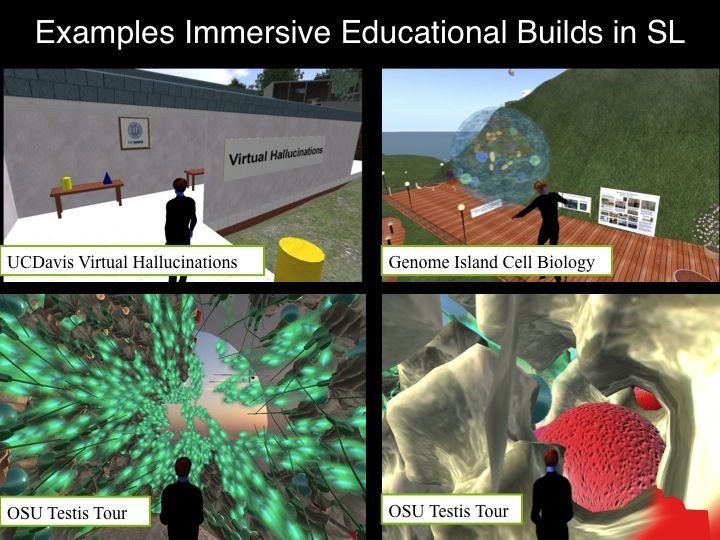
Some virtual worlds, such as Second Life, are not only a platform in which educators can meet with students at a distance but they also contain what is often referred to as immersive builds. Below is a snapshot showing a number of these places. They are oftentimes interactive, immersive places, which have been designed and/or created by educators to assist students with their learning. As a SL librarian, who has been evaluating inworld immersive learning spaces, I am able to provide students with ways to find and access these places as an additional information resource beyond books, videos, articles and websites.
For those not familiar with VWs and/or SL, this site shows some of the institutions teaching and learning in SL (this is a partial list and many who are still in the exploration stage (such as my univ) are not listed).
Now back to the title of this post and questions for any readers who happen upon it--Should academic librarians provide assistance in virtual worlds?
Does my work as a SL librarian fit the role of an academic librarian? Obviously, I believe it does. I have presented and blogged on the role of the academic librarian in virtual worlds in the past, and belong to the ACRL in SL group where I network with incredibly innovative librarians in SL. I also closely follow the work of the ALA in Second Life and have attended their events when time allows. But I'm interested in what the rest of the academic community thinks. If I'm wrong about this, please comment and tell me why.
I'm not saying every librarian should be conversant in virtual worlds. Academic libraries typically have librarians who specialize in specific areas. Does it make sense to have a librarian who is conversant and able to assist when needed by faculty teaching classes in those worlds? Might some institutions consider this an asset?
Is creating inworld subject guides a role others see as fitting for an academic librarian? Should librarians be leading in this way or should we wait until virtual worlds are more mainstream? If we wait, is there a chance our role will be filled by others such as educational technologists? (I would argue that edtechs have the skills needed to lead as administrators/creators of our institution's spaces in virtual worlds and that librarians should be the main information need providers.)
Many of the library and information science graduate schools now offer classes on virtual worlds. Do academic library directors see the value in that when making hiring decisions?
I am an early adopter of technology (though not a techie) and have learned over the years that sometimes I can be too early, and sometimes I am wrong about a trend. But, I like to think of academic librarians as trailblazers and believe we should be leaders and not afraid to take risks.
There is a digital revolution taking place and it's an exciting time to be a librarian. As we contemplate how the next five years will develop, how we prepare ourselves to remain relevant as academic librarians seems more important than ever. If our constituents are (or will be in the near future) teaching and/or learning in virtual worlds, I feel some librarians should be there.
Comments are welcome.
The mission of the George Fox University library is to support the instructional programs and research activities of the institution by providing access to recorded information in a variety of formats, and to provide instruction in the use of traditional and new information resources and technologies.
Having already been in SL for some time (mainly learning, networking for professional development purposes with other librarians/educators), I felt ready for the challenge of serving as a "SLibrarian." My prior interest/preparation stemmed from my belief that teaching & learning would continue to grow in VWs and I felt some librarians should be involved. I knew my university had already used SL for one class and thought there would eventually be more.
After meeting with the professor of the course to discuss my role and course needs, I went to work creating resources to address the information needs. I placed those resources along with a librarian office building on the skydeck George Fox University (GFU) leases from New Media Consortium.
The GFU skydeck space was ready before class started and was used for many purposes. Examples of how I assisted in my role as librarian include, helping to orient our graduate/doctoral students who were using SL for the first time by creating "how to" informational posters, attending the one hour per week inworld (inside SL) class to assist as needed, providing one-on-one help with students during inworld office hours or by appt., adding content to the course wiki, creating inworld subject guides, and meeting occasionally with the prof to discuss/assess learning outcomes related to the course assignments.
The professor and I continued to collaborate throughout the course and I learned a great deal working in the role I saw as a type of embedded librarian in Second Life. Or maybe I should say a blended librarian or a combination of both? Here is a flickr slideshow link of the class from last summer (click "show info").
This semester I was asked to teach my own SL course as an adjunct instructor for our School of Education (SOE) EDFL program. The one credit hour graduate level edtech course, "Intro to Second Life for Educators," has progressed nicely and has been quite the learning experience for all involved. This time I've really taken on two roles, one as the instructor and the other as the librarian. I created a course wiki where I link to many different types of information resources. Everything from blog posts to online news articles to shared links of searches I ran for scholarly peer reviewed articles in our Ebsco databases, and I've continued developing inworld subject guides.
As part of last week's inworld asynchronous assignment, I asked the class to watch the short YouTube video I created below on using Sloog for inworld subject guides (meaning subject guides of places in SL). (The assignment this past week was to use the Sloog website beginning with my Sloog user page in the way I describe in the video to visit Genome Island, explore and then write a reflection on our course wiki about their experience.)
(Click this link to view in larger format on YouTube site.)
Subject guide (sometimes known as resource guide, etc.) creation is seen as a fairly standard task amongst academic librarians. We create guides which include links to books in our catalogs, article databases, websites we've evaluated and feel may be useful, etc. Some librarians have also begun pointing out valuable Web 2.0 resources in their subject areas.
Virtual worlds (VW) are another platform containing new formats of information. There are over 150 VWs and their numbers are increasing rapidly. Those interested in VW growth projections can take a look at this post on Gartner's report and this site which shows large growth in the elementary school age demographic (our not too distant higher ed students).
Some virtual worlds, such as Second Life, are not only a platform in which educators can meet with students at a distance but they also contain what is often referred to as immersive builds. Below is a snapshot showing a number of these places. They are oftentimes interactive, immersive places, which have been designed and/or created by educators to assist students with their learning. As a SL librarian, who has been evaluating inworld immersive learning spaces, I am able to provide students with ways to find and access these places as an additional information resource beyond books, videos, articles and websites.
For those not familiar with VWs and/or SL, this site shows some of the institutions teaching and learning in SL (this is a partial list and many who are still in the exploration stage (such as my univ) are not listed).
Now back to the title of this post and questions for any readers who happen upon it--Should academic librarians provide assistance in virtual worlds?
Does my work as a SL librarian fit the role of an academic librarian? Obviously, I believe it does. I have presented and blogged on the role of the academic librarian in virtual worlds in the past, and belong to the ACRL in SL group where I network with incredibly innovative librarians in SL. I also closely follow the work of the ALA in Second Life and have attended their events when time allows. But I'm interested in what the rest of the academic community thinks. If I'm wrong about this, please comment and tell me why.
I'm not saying every librarian should be conversant in virtual worlds. Academic libraries typically have librarians who specialize in specific areas. Does it make sense to have a librarian who is conversant and able to assist when needed by faculty teaching classes in those worlds? Might some institutions consider this an asset?
Is creating inworld subject guides a role others see as fitting for an academic librarian? Should librarians be leading in this way or should we wait until virtual worlds are more mainstream? If we wait, is there a chance our role will be filled by others such as educational technologists? (I would argue that edtechs have the skills needed to lead as administrators/creators of our institution's spaces in virtual worlds and that librarians should be the main information need providers.)
Many of the library and information science graduate schools now offer classes on virtual worlds. Do academic library directors see the value in that when making hiring decisions?
I am an early adopter of technology (though not a techie) and have learned over the years that sometimes I can be too early, and sometimes I am wrong about a trend. But, I like to think of academic librarians as trailblazers and believe we should be leaders and not afraid to take risks.
There is a digital revolution taking place and it's an exciting time to be a librarian. As we contemplate how the next five years will develop, how we prepare ourselves to remain relevant as academic librarians seems more important than ever. If our constituents are (or will be in the near future) teaching and/or learning in virtual worlds, I feel some librarians should be there.
Comments are welcome.
Thursday, November 20, 2008
An Interview with UIUC GSLIS Student on Librarians and Second Life
A UIUC graduate student, Sue Bergren (Sue Karillion in SL), wrote yesterday asking if she could interview me for a paper she was writing as part of a practicum in SL this semester. She explained that she had attended my online presentation at the Virtual Librarian Conference , was reading my blog and had some questions. I was glad to answer as it caused me to reflect on what I've been doing and where I'm headed. Thanks, Sue!
How can librarians provide value in a virtual world? - As a librarian, what do you do in SL? - Would you give me some examples of what you do?
I think we need to keep our eyes on the mission of our libraries and work to that end while in Second Life (SL), and by doing so we will provide value.
I am an academic librarian and according to my library's mission statement we are "to support the instructional programs and research activities of our institutions by providing access to information in a variety of formats, and to provide instruction in the use of traditional and new information resources and technologies." I see SL as many things, including another format of information. Most everything I do as a librarian in SL lines up with my library's mission statement.
As a librarian I do a variety of things in SL. This past summer I assisted a professor from my institution in teaching his first class in SL. I researched the best resources for helping his students to get started in SL and then included those in a wiki we developed for his class. I was given a skydeck to develop above some land we leased and went about setting up an office building with resources I felt would be helpful for his students. I created tutorial posters and an informational display on education in SL. Most importantly, I assisted students with their information needs in much the same way I assist students needing help with library databases. I met with students and the professor inworld when requested and built strong relationships with all.
Finally, I collaborate with other librarians inworld and volunteer on the reference desk at Info Island International once per week. The professional development and networking potential (global networking at that!) was something I did not immediately value and which I now find to be incredibley valuable. A whole new world has opened up for me. I've always wanted to travel and meet others from around the country and the world. Not only do I do that in SL, but we share and collaborate in ways that simply are not possible in 1st life. I attend information literacy discussions 2-3 times a month on Infolit iSchool Island hosted by Univ of Sheffield faculty/lecturer, Sheila Webber. I attend professional association meetings without putting a dent in my university's travel budget. I meet, work and play with librarians and educators from around the world on a regular basis. Sometimes when I leave these meetings I walk away (well...fly or teleport usually) and think about events I've attended in 1st life. Events/conferences for which I spent money for travel and paid to attend, and I marvel that my experiences attending events inworld tend to be as good and many times better. I learn and grow in Second Life.
(Click the small square w/arrows in right corner to enlarge & see descriptive info and again to go back.)
How long have you been using SL? - Why did you choose SL over some of the other virtual worlds?
I have been in SL since June 2006, but was not very active at all during my first year. SL was less developed at that time, there were fewer orientation options, and I struggled with learning the technology. I did, however, see the potential and as an early adopter I kept going back until I eventually became comfortable.
I chose SL over other virtual worlds because it is currently the most developed, especially in the area of education. This may change with the many VWs in development. I explore other VWs at times and work to keep abreast of VW developments.
What are your plans for the future?
Now that I'm known at my university as the "SLibrarian," I am the go-to person for anyone who has questions on SL from profs to students to administrators. I will continue to do my best to assist with any questions/needs they may have regarding this newer technology.
I am also working in SL with other librarians on ways we can best work to serve others and each other in SL. I belong to the American Librarian Association (ALA) group in SL as well as the Association of College & Research Libraries (ACRL) group in SL.
I am currently working on a project that involves creating inworld educational subject guides using an inworld/outworld tool called Sloog. In the same way that librarians create subject guides for web resources, there is a growing need for such guides inworld. I hope to share about this project at an ACRL in SL meeting in the near future and recently lead a discussion on Infolit iSchool Island on this topic.
Lastly, I am working on a couple of other non-profit ventures in SL. There are so many opportunities to be involved inworld, I find it can be difficult to say no to some of them. SL is an excellent way for early adopter librarians to keep abreast of emerging technologies and to take a lead role in the brave new vitual worlds of our future.
How can librarians provide value in a virtual world? - As a librarian, what do you do in SL? - Would you give me some examples of what you do?
I think we need to keep our eyes on the mission of our libraries and work to that end while in Second Life (SL), and by doing so we will provide value.
I am an academic librarian and according to my library's mission statement we are "to support the instructional programs and research activities of our institutions by providing access to information in a variety of formats, and to provide instruction in the use of traditional and new information resources and technologies." I see SL as many things, including another format of information. Most everything I do as a librarian in SL lines up with my library's mission statement.
As a librarian I do a variety of things in SL. This past summer I assisted a professor from my institution in teaching his first class in SL. I researched the best resources for helping his students to get started in SL and then included those in a wiki we developed for his class. I was given a skydeck to develop above some land we leased and went about setting up an office building with resources I felt would be helpful for his students. I created tutorial posters and an informational display on education in SL. Most importantly, I assisted students with their information needs in much the same way I assist students needing help with library databases. I met with students and the professor inworld when requested and built strong relationships with all.
Finally, I collaborate with other librarians inworld and volunteer on the reference desk at Info Island International once per week. The professional development and networking potential (global networking at that!) was something I did not immediately value and which I now find to be incredibley valuable. A whole new world has opened up for me. I've always wanted to travel and meet others from around the country and the world. Not only do I do that in SL, but we share and collaborate in ways that simply are not possible in 1st life. I attend information literacy discussions 2-3 times a month on Infolit iSchool Island hosted by Univ of Sheffield faculty/lecturer, Sheila Webber. I attend professional association meetings without putting a dent in my university's travel budget. I meet, work and play with librarians and educators from around the world on a regular basis. Sometimes when I leave these meetings I walk away (well...fly or teleport usually) and think about events I've attended in 1st life. Events/conferences for which I spent money for travel and paid to attend, and I marvel that my experiences attending events inworld tend to be as good and many times better. I learn and grow in Second Life.
(Click the small square w/arrows in right corner to enlarge & see descriptive info and again to go back.)
How long have you been using SL? - Why did you choose SL over some of the other virtual worlds?
I have been in SL since June 2006, but was not very active at all during my first year. SL was less developed at that time, there were fewer orientation options, and I struggled with learning the technology. I did, however, see the potential and as an early adopter I kept going back until I eventually became comfortable.
I chose SL over other virtual worlds because it is currently the most developed, especially in the area of education. This may change with the many VWs in development. I explore other VWs at times and work to keep abreast of VW developments.
What are your plans for the future?
Now that I'm known at my university as the "SLibrarian," I am the go-to person for anyone who has questions on SL from profs to students to administrators. I will continue to do my best to assist with any questions/needs they may have regarding this newer technology.
I am also working in SL with other librarians on ways we can best work to serve others and each other in SL. I belong to the American Librarian Association (ALA) group in SL as well as the Association of College & Research Libraries (ACRL) group in SL.
I am currently working on a project that involves creating inworld educational subject guides using an inworld/outworld tool called Sloog. In the same way that librarians create subject guides for web resources, there is a growing need for such guides inworld. I hope to share about this project at an ACRL in SL meeting in the near future and recently lead a discussion on Infolit iSchool Island on this topic.
Lastly, I am working on a couple of other non-profit ventures in SL. There are so many opportunities to be involved inworld, I find it can be difficult to say no to some of them. SL is an excellent way for early adopter librarians to keep abreast of emerging technologies and to take a lead role in the brave new vitual worlds of our future.
Saturday, November 1, 2008
The ALA, Libraries and Second Life


The American Library Association Virtual Communities and Libraries Membership Initiative Group (ALA VCL MIG) is pleased to announce its first ALA SLymposium to be held in the virtual world of Second Life(SL) on ALA island on Saturday November 8. There is no charge for the event. I'm posting here to encourage library workers to register and attend.
The recent growth and development by the global public and education community in SL means that our roles as library workers may be evolving. There are information needs in virtual worlds (VWs) that parallel those needs in real life. As an academic librarian, who is active in SL by both supporting faculty from my university who teach in SL as well as volunteering weekly on the Info Island International reference desk, I feel I benefit greatly from my involvement (as do those I serve). Here is a link to the ALA in Virtual Worlds wiki which includes additional links to information.
In future blog posts I'll also be writing on the activities of the ACRL (Association of College & Research Libraries) in SL Group, of which I am a member.
The ALA island was developed in 2007 and there are events and discussions held regularly. The photo included here is from a recent discussion on ALA Island. Oberon Octagon, ALA Island Manager (the tiger avatar in the closeup photo), talked about ALA Island and what it can do for us. One new project the ALA is working on involves assisting those library workers who are new to SL with orientation needs. Proper SL orientation is important for all newcomers and I was glad to hear this.
For those who may be wondering how committed ALA is to SL, here is info I copied from the ALA Staff in SL Group Charter
The American Library Association is the oldest and largest library association in the world, with more than 65,000 members. Its mission is to promote the highest quality library and information services and public access to information.
Our presence in Second Life marks a commitment to virtual membership by the members of ALA Staff.
This island was made possible through a donation by San Jose State University School of Library and Information Science.
I'm glad to see the ALA is following the virtual worlds movement and willing to support library workers on the cutting edge. Time will tell just how successful SL will be. For now it is by far the most developed VW with the largest presence of library workers. As more library workers become involved in SL, more ALA staff involvement/support will be supplied. Attend the ALA Slymposium if you possibly can and see for yourself what is happening with libraries/library staff and Second Life.
Tuesday, October 14, 2008
The Virtual Librarian Conference October 2008
October 1-2, 2008, I attended and presented at The Virtual Librarian Conference. The conference was held online and delivered via Adobe Connect.
My presentation was on the role of the academic librarian in virtual worlds. The focus was on my experiences as my university's main academic librarian in SL. I will embed my updated slideshare presentation here for those who are interested. My original presentation was 14 slides. Since it involved application sharing of a flickr slideshow I had to turn some of those snapshots into ppt slides so the presentation would work without the app sharing. Hopefully this will make sense to viewers of my Slideshare presentation. (If you see formatting problems in the embedded ppt below, please click the title link to watch on the Slideshare site.)
My Session took place on Day 2 of the conference and though I have attended many webinars using Adobe Connect, Elluminate, etc., I had never presented using one of these programs. That alone was a good learning experience for me. Since I decided I wanted to use application sharing in the middle of my presentation, I was stretched a little further by learning how to use some advanced features.
The conference attendees were made up of a little over 80% librarians along with a few educational technologists, etc. Many attendees freely participated in the discussion via comments and questions using chat which always adds value to the presentations.
There were four separate sessions each day including a panel discussion during day 1 made up of four people including Barbara A. Galik, Executive Director, Cullom-Davis Library, Bradley University (aka Puglet Dancer in SL). I was glad to see this and I enjoyed hearing the different viewpoints on the panel.
I recently interviewed Barbara Galik (Puglet Dancer, as the interview took place in SL) regarding her role as an academic librarian in Second Life. At the time I did not know she was the Bradley Univ library director or that she was the main person responsible for the Bradley University presence in SL (things I discovered during the interview). I find that I learn much by following trailblazers like Barbara, Lori Bell and others who presented and contributed during the conference.
It was helpful to learn more about the history of the Alliance Virtual Library during day 1 of the conference from those who founded the project and were involved from the beginning. Lori Bell and Abbey/Rhonda Trueman did a nice job explaining how this amazing project came about and how it is progressing. Joe Sanchez gave an interesting talk about librarianship in virtual worlds and the work he is doing in SL with students from the University of Texas at Austin. Here is a blog link for Joe on the Educators Coop in SL, which I have visited in SL and will continue to follow.
Day 2 of the conference was equally valuable. Jeremy Kemp of SJSU has considerable experience teaching and learning in SL and has accomplished excellent work inworld. From Sonja Plummer-Morgan, a public library director from Northern Maine, I learned about some of the administrative issues around building a library presence in SL and the great work she is doing with her library and as a volunteer for other organizations. And finally the conference ended with Matt Krull's presentation on "Creating Educational Tools in Second Life for Libraries.” Matt is a creative and talented individual. Educators in SL would be in trouble without people like Matt- people who understand the potential of virtual worlds and have the know-how to develop tools to help us fully utilize all VWs have to offer.
My presentation was on the role of the academic librarian in virtual worlds. The focus was on my experiences as my university's main academic librarian in SL. I will embed my updated slideshare presentation here for those who are interested. My original presentation was 14 slides. Since it involved application sharing of a flickr slideshow I had to turn some of those snapshots into ppt slides so the presentation would work without the app sharing. Hopefully this will make sense to viewers of my Slideshare presentation. (If you see formatting problems in the embedded ppt below, please click the title link to watch on the Slideshare site.)
My Session took place on Day 2 of the conference and though I have attended many webinars using Adobe Connect, Elluminate, etc., I had never presented using one of these programs. That alone was a good learning experience for me. Since I decided I wanted to use application sharing in the middle of my presentation, I was stretched a little further by learning how to use some advanced features.
The conference attendees were made up of a little over 80% librarians along with a few educational technologists, etc. Many attendees freely participated in the discussion via comments and questions using chat which always adds value to the presentations.
There were four separate sessions each day including a panel discussion during day 1 made up of four people including Barbara A. Galik, Executive Director, Cullom-Davis Library, Bradley University (aka Puglet Dancer in SL). I was glad to see this and I enjoyed hearing the different viewpoints on the panel.
I recently interviewed Barbara Galik (Puglet Dancer, as the interview took place in SL) regarding her role as an academic librarian in Second Life. At the time I did not know she was the Bradley Univ library director or that she was the main person responsible for the Bradley University presence in SL (things I discovered during the interview). I find that I learn much by following trailblazers like Barbara, Lori Bell and others who presented and contributed during the conference.
It was helpful to learn more about the history of the Alliance Virtual Library during day 1 of the conference from those who founded the project and were involved from the beginning. Lori Bell and Abbey/Rhonda Trueman did a nice job explaining how this amazing project came about and how it is progressing. Joe Sanchez gave an interesting talk about librarianship in virtual worlds and the work he is doing in SL with students from the University of Texas at Austin. Here is a blog link for Joe on the Educators Coop in SL, which I have visited in SL and will continue to follow.
Day 2 of the conference was equally valuable. Jeremy Kemp of SJSU has considerable experience teaching and learning in SL and has accomplished excellent work inworld. From Sonja Plummer-Morgan, a public library director from Northern Maine, I learned about some of the administrative issues around building a library presence in SL and the great work she is doing with her library and as a volunteer for other organizations. And finally the conference ended with Matt Krull's presentation on "Creating Educational Tools in Second Life for Libraries.” Matt is a creative and talented individual. Educators in SL would be in trouble without people like Matt- people who understand the potential of virtual worlds and have the know-how to develop tools to help us fully utilize all VWs have to offer.
Wednesday, September 17, 2008
Educause Review - Sept/Oct 2008 Virtual Worlds - Must Read For Those In Higher Education

I've barely finished reading half of this Educause Review volume, but felt I had to post something here to get this out there.
If you work in higher education, whether you're staff, faculty or administrator - it's important that you read the articles in this volume. It's important for the present and the future of higher education.
I regularly run into people in higher ed who have not heard of the phrase "virtual worlds." I just don't think we can afford to not know any longer. In the past I've considered what others in higher ed have said to me about how Second Life is not for everyone. And it may not be. But the fact is, virtual worlds will be an important part of the future of higher education.
My university and many others regularly talk about how we need to engage students in the teaching and learning process. Virtual worlds are an excellent tool for this purpose.
Tuesday, September 16, 2008
Virtual Worlds and the Future of Business Education


I attended an informative 3.5 hr conference yesterday in Second Life (SL) titled "Virtual Worlds and the Future of Business Education." I was curious because I've been seeing more signs on campuses in SL lately for MBA programs. Here's the link - it was a very good conference, well worth my time (day off). The speakers were excellent and the backchat and tweets were valuable too. There were 80 inworld avatars attending and the conference was also streamed live on the 2D web.
Pathfinder Linden (of Linden Labs, the company behind SL) even answered a question I asked on when SL will allow for shared applications (it's coming!). As a librarian this would increase the usefulness of using SL with students. Not all educators see why this request is important but for librarians it can matter as we demonstrate to students how to use specific databases. If you are a prof who is using SL to teach students it probably wouldn't be important as SL already allows for collaborative work using Google docs inworld.
A couple of points that stood out for me were by Anne Massey, Dean's Research Professor and Professor of IS at Kelley. One was on the hype cycle and where SL is now and if you click the snapshots here to enlarge you will see the chart. I recently read an article on this, which came to the same conclusion. The other point was on the seven sensibilities of SL. Things that all who spend time in SL understand, but which can be difficult to explain to those who have not experienced SL much themselves. Briefly the 7 sensibilities in which she referred - sense of self, death of distance, power of presence, sense of space, capability to co-create, pervasiveness of practice and enrichment of experience.
Another point made by Anne Massey and Sarah Robbins (aka Intellagirl) had to do with how the usefulness of SL is what's going to drive adoption and what will get people over the ease of use hump. That really resonated with me as in my early days of SL my realization of how powerful of a tool this virtual world could be, especially for higher education, was what kept me going at times. And of course the usefulness of SL is growing almost daily. This is partly due to the innovative work being done in SL by very creative and talented educators and technologists.
Of course there was specific focus on business education here, though I found most of what was shared would be applicable to many disciplines. One reason I heard that business education makes sense in SL is because of the need to connect globally and the ease in which people can do that in virtual worlds. Also businesses are finally figuring out how to use virtual worlds. Here's a link to a 2008 O'Reilly Radar Report titled "Virtual Wordls: A Business Guide" for those who are interested.
Bottom line, Second Life and other virtual worlds are here to stay. Forward thinking universities and colleges who understand this will reap the benefits of being early adopters of these platforms. Especially institutions that are struggling with tight budgets, this a way to benefit greatly for minimal cost.
Monday, June 9, 2008
Reflection: An Academic Librarian - Leading My First Discussion In Second Life

This post is a reflection on my experience leading a discussion on InfoLit Island in Second Life (SL). Here is my original post: "An Academic Librarian-Leading My First Discussion In Second Life."
All in all, the discussion went well. It was well attended and I received positive feedback. Most valuable to me was what I learned from the experience. I had already attended a number of events and discussions in SL so I was familiar with the chat discussion format. I found that attending/participating in a dicussion and leading a discussion using chat are very different experiences. I found it both challenging and rewarding.
I knew I couldn't fully prepare because you never know what will happen in SL. Sometimes there are technical issues (and a couple of attendees did crash during my discussion). And sometimes people show up in the middle of a discussion and want to know what is being discussed (that happened too). But usually there are core folks who attend because they are interested in the topic and really want to learn something. You have an opportunity to share what you know and to learn from others who attend.
So how did I prepare? Well I spent more time than I want to admit researching the main tool I would discuss, the Sloog HUD (an in-world social bookmarking tool much like del.icio.us). I also spent a fair amount of time looking into the Salamander HUD.
Next, I created my notecard in SL and sent that on to Sheila Webber, the island owner, so she could set up the poster, etc. in the building where we would meet (the notecard is what the attendees receive when they touch the poster and is all about the topic I chose titled, "Expanding/Enhancing Information Literacy Using In-World Tools.").
I then wrote some notes that I would share with those who attended using Google docs so that I could copy and paste into the chat text field as I lead the discussion. I figured that would help things move along a little smoother. And it did, but it also hindered some as I had to be sure to keep track of where I was in my notes and keep track of the questions people were asking, and greeting people who arrived late and so forth. I also thought the notes would help me to stay on topic, and they did serve that purpose, though with discussions of this type you also have to follow the attendee questions to a degree. And that's not as easy as one might think.
One of the main problems I had was that I rushed things. I was concerned about not covering everything. I really wish I had allowed more time for people to continue writing where they were from and for questions and input from the attendees.
The biggest mistake I made had to do with timing as well. After about 25 min. into the 1 hr. disucssion, I asked whether the group would like to walk outside to get one of these tools themselves from the vend machines I had brought. I was excited about having them do this (it's always fun to get free things in SL), and I still think it was a great idea, but I really wish I had continued for 20 more minutes and then at the end offered them an opportunity to get a free Sloog and Salamander HUD. It was tricky to get everyone back in the building. I should have known better because if you gave me a new tool in the middle of anything, I too would be playing with it the rest of the time.
Once folks were back in, the questions had a lot to do with how the HUDs worked. This information was included in the help notecard that comes with the HUDs, but of course most had not had time yet to read those. So anyway, I did not really get to cover as much as I would have if I had waited until the end to share the tools.
So now I know I would do some things differently if I ever lead a discussion again. And I also feel I gained confidence in leading this way. The more time I spend in SL actually doing things, the more confident I feel. Even non-techie folk like myself can lead in virtual worlds. It's really a matter of being willing to spend the time to learn how things work. And a willingness to take risks, and maybe make a fool of yourself at times helps. I found that since I could hide a little behind my avatar, that it wasn't quite as nerve wracking as giving a presentation to a group in real life. But it was close. And I feel like I gained confidence through this experience that will help me with real life presentations as well.
Here is a link to the chatlog (transcript) of the discussion. Here is a link to Sheila's blog "Adventures of Yoshikawa" post on my discussion (check out her whole blog by clicking on the home link towards the bottom). A copy of the notecard as a pdf that was handed out from the poster can be found here as well, along with a slurl link to her InfoLit Island in SL (in case you want to visit). This one also contains some good snapshots of the event. I was too busy to take any myself that day. Though I will include one here I took the night before while getting ready.
And here is a link to the Information Literacy Weblog post on my discussion, that Sheils Webber co-authors along with Stuart Boon. I so appreciate all Sheila's hard work in providing a venue for discussions on her island. I've learned a lot from her and recommend her information literacy discussions to all.
Wednesday, May 28, 2008
An Academic Librarian - Leading My First Discussion in Second Life

Here is the event announcement from the SLED (Second Life Educators) calendar (click to enlarge). I am excited about this opportunity. And though it is an informal discussion, I have been regularly attending these weekly information literacy discussions in SL for some time now and always learn something useful to my work as an academic librarian. And most enlightening for me, in some ways, has been that the majority who attend are not from the USA. These discussions have helped me to consider information literacy with a broader perspective. I'm thankful for that alone.
About Sheila Webber,(the Infolit iSchool Island owner) - She is a Senior lecturer (i.e. a faculty member - most faculty in UK universities aren't called professors!) in the Department of Information Studies at the University of Sheffield, where she has taught since 2000.
Sheila has been a wonderful role model for me and gracious enough to invite me to lead one of her discussions. I am learning a great deal from her - not only about information literacy, but about teaching and learning in Second Life. Here is a link to her shared information literacy blog, and here is a link to a bio, which includes some of her many publications. And that doesn't include her work in SL. You will want to take a look at her "Adventures of Yoshikawa" blog for that.
I do not know how she finds the time to accomplish all that she has. I am inspired by what Sheila has done as both an information professional and a SL resident. She saw the potential in this wonderful virtual world to take teaching and learning to the next level, and she is giving it her all.
Sunday, April 6, 2008
Virtual Worlds & Higher Education - Update
An earlier post, Educators, Second Life, & Higher Education was an attempt to explain my thoughts and progression in Second Life. I've also posted on immersive education and other virtual worlds. I follow these trends as an educator in higher education because I believe they will continue to develop and could play an integral role in higher education, especially for distance learners. As the distance services librarian for my university it is important for me to stay appraised of these developments. And traditional undergrad campuses may also benefit from offering some courses in virtual worlds as an appealing choice for students who prefer to learn in more immersive learning environments.
Many in higher ed are also following the growth of online learning. The Sloan Consortium report, "Online Nation: Five Years of Growth in Online Learning" is available if interested. Of course online learning has taken place for decades now, but the platform used has typically been various types of learning management systems. These systems have been adequate in the past, but many learners could benefit from the more immersive learning environments available via virtual worlds.
I have been following virtual worlds in general for some time and have wondered which virtual world will end up being best suited to the needs of educators. Sometimes those thoughts have caused me to hesitate when it comes to being more fully engaged in Second Life (SL), currently the most developed virtual world (VW). There are many VWs in the works, some have been in development for many years and still have not publicly launched. A large amount of resources are being used to develop these VWs. Some have a strong focus on education, others on business applications, governments and non-profits, social networking, etc. There is a lot of momentum at the moment, and I believe in the next 1-2 years there will be significant developments. And I could be wrong, but I believe virtual worlds will eventually become commonplace within higher education.
Second Life includes many diverse communities. These communities are being closely monitored by businesses, educators, etc. to learn which are growing and best suited for the SL environment. Though SL was publicly released in 2003, and there was incredible growth for a period of time, it is still being defined and developed by the founders and users alike. Will SL end up being the best platform for higher education? I'm not sure but time will tell. I do know that there is a surge of creative activity taking place at the moment in this area. Educators of all kinds are seeing potential in SL that was not as apparent until recently. Partly this has to do with innovative technologies that have been recently implemented within the SL environment. Developments by Linden Labs like voice, along with third party applications being developed by technologists in higher ed and others has made a difference and should continue to enrich the environment.
I've been visiting islands and educational institutions in SL. If interested here is a link to "My Second Life Adventures" on flickr. I recommend you click "view as slideshow" and be sure to click on the center of the first slide so the description for each slide shows.
There have been other recent developments regarding virtual worlds. Some are considered quite important and significant by many who are tracking the virtual world phenomenon. Later this week I will share links to recent news reports on some of these developments.
Many in higher ed are also following the growth of online learning. The Sloan Consortium report, "Online Nation: Five Years of Growth in Online Learning" is available if interested. Of course online learning has taken place for decades now, but the platform used has typically been various types of learning management systems. These systems have been adequate in the past, but many learners could benefit from the more immersive learning environments available via virtual worlds.
I have been following virtual worlds in general for some time and have wondered which virtual world will end up being best suited to the needs of educators. Sometimes those thoughts have caused me to hesitate when it comes to being more fully engaged in Second Life (SL), currently the most developed virtual world (VW). There are many VWs in the works, some have been in development for many years and still have not publicly launched. A large amount of resources are being used to develop these VWs. Some have a strong focus on education, others on business applications, governments and non-profits, social networking, etc. There is a lot of momentum at the moment, and I believe in the next 1-2 years there will be significant developments. And I could be wrong, but I believe virtual worlds will eventually become commonplace within higher education.
Second Life includes many diverse communities. These communities are being closely monitored by businesses, educators, etc. to learn which are growing and best suited for the SL environment. Though SL was publicly released in 2003, and there was incredible growth for a period of time, it is still being defined and developed by the founders and users alike. Will SL end up being the best platform for higher education? I'm not sure but time will tell. I do know that there is a surge of creative activity taking place at the moment in this area. Educators of all kinds are seeing potential in SL that was not as apparent until recently. Partly this has to do with innovative technologies that have been recently implemented within the SL environment. Developments by Linden Labs like voice, along with third party applications being developed by technologists in higher ed and others has made a difference and should continue to enrich the environment.
I've been visiting islands and educational institutions in SL. If interested here is a link to "My Second Life Adventures" on flickr. I recommend you click "view as slideshow" and be sure to click on the center of the first slide so the description for each slide shows.
There have been other recent developments regarding virtual worlds. Some are considered quite important and significant by many who are tracking the virtual world phenomenon. Later this week I will share links to recent news reports on some of these developments.
Tuesday, March 11, 2008
University Gives Away iPhones & Apple Computers
Yesterday I posted on Abilene Christian University and their plan to give students a choice between an iPhone or an iPod Touch and the teaching/learning applications they hope to implement on these devices. Days later another Chronicle article announced that Oklahoma Christian (OC) University will give away both an iPhone/iPod Touch AND an Apple laptop computer to all incoming freshman this next fall. According to the OC web page regarding mobile learning:
If they were giving away gadgets and computers with no plan in place to incorporate these technologies into the teaching and learning process, then I might agree. But as Phil J. Schubert, executive vice president for Abilene University stated, "What separates us from some of the fads of the past is that this is not a technology initiative, this is a learning initiative." And this is what I feel is important to understand. It doesn't really matter what device is used, what matters is what they will do with that device to add value. Students are already attached to handheld devices of some kind, therefore there is no need to wonder if they will use them. If colleges and universities implement teaching/learning applications that make sense and are easy to use, I believe they will be successful and mobile learning in the U.S. will finally take off.
So once again, if/when this happens, what will it mean to educators (and that includes librarians), in higher education? How might we contribute to this new teaching/learning platform?
The vision of incorporating instructional technology tools into teaching and learning is critical to our future success and the success of our graduates. We are excited about this new phase of mobile learning at Oklahoma Christian University and will continue to search for ways to enhance teaching and learning.On March 5, 2008 yet another Chronicle article suggests that giving away gadgets such as these is just a gimmick.
If they were giving away gadgets and computers with no plan in place to incorporate these technologies into the teaching and learning process, then I might agree. But as Phil J. Schubert, executive vice president for Abilene University stated, "What separates us from some of the fads of the past is that this is not a technology initiative, this is a learning initiative." And this is what I feel is important to understand. It doesn't really matter what device is used, what matters is what they will do with that device to add value. Students are already attached to handheld devices of some kind, therefore there is no need to wonder if they will use them. If colleges and universities implement teaching/learning applications that make sense and are easy to use, I believe they will be successful and mobile learning in the U.S. will finally take off.
So once again, if/when this happens, what will it mean to educators (and that includes librarians), in higher education? How might we contribute to this new teaching/learning platform?
Subscribe to:
Posts (Atom)


