Showing posts with label distance education. Show all posts

Sunday, July 11, 2010

QR Codes in Libraries


QR Codes are appearing more frequently in the U.S., though the technology is still largely unknown to the majority and mainstream adoption will take time. Recent developments are raising awareness of QR codes in the country (UPDATE 7/29 more major QR code exposure), and librarians in libraries everywhere are busy experimenting, learning from each other and sharing results.

I created  an introductory flier to share with students and faculty as we continue to research and brainstorm ways to utilize QR codes in the library and on campus.

The Portland Center of my university, where I work as a reference librarian, serves primarily graduate and doctoral students. They are busy adults, many with families working full-time jobs while attending graduate school. Any new technology that is introduced must have enough value to warrant their time and effort. Because QR Code technology is very simple to use, I think there is a good chance of seeing this technology utilized IF doing so makes their lives easier (i.e., QR codes on study room doors to take users directly to the room reservation online form can save time and effort). The main undergraduate campus library has also introduced QR codes and it will be interesting to observe usage between the different groups.

The Journal of Information Literacy recently published an article by Andrew Walsh titled, "QR Codes – using mobile phones to deliver library instruction and help at the point of need." From the Abstract:
This article outlines the practical uses we have found for QR codes, gives preliminary results of how those have been received by our library users in our pilot study and highlights the reluctance of many students to engage with this technology, which may need further investigation.
It's a worthwhile read from which we can learn a great deal, but keep in mind the research was done close to a year ago and there have been significant changes since that time. Many of the same challenges exist today, especially in the U.S. where we are lagging in the use of QR codes and other mobile technologies. However, awareness of QR codes is growing in the US, and QR code technology has developed greatly the last few months in both quantity and quality of apps. I've personally culled a number of apps as better apps have been made available (no longer is taking a picture necessary on some devices as newer apps quickly and accurately scan the codes).

The author also mentions that QR codes are "an easier alternative to full augmented reality," and I agree. However, augmented reality is another technology that has seen significant development over the past few months. I've been experimenting with augmented reality (AR) apps, which I hope to utilize for library tours and other purposes (blog post to come - done and here). At the moment (until the next new technology) I feel that both QR codes and AR will have a place in the library and the university. This post on augmented reality and handheld devices from a year ago highlights the different amazing apps at that time and I expect to continue to see gains in AR and QR code development.

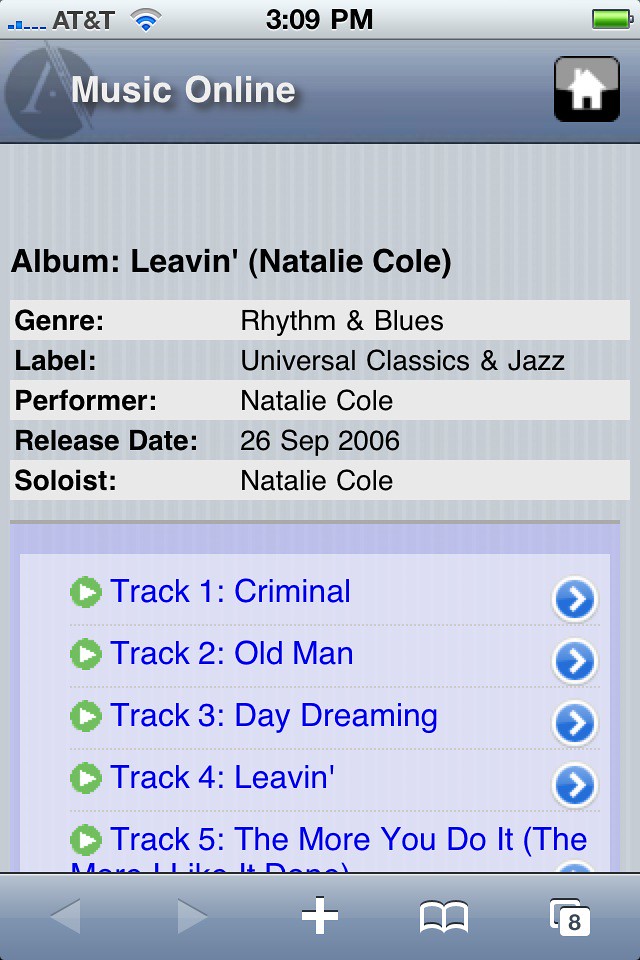
Lastly, this past Friday I discovered (via a tweet to a flickr screen shot) that Alexander Street Press (ASP) had made QR codes available in their Music Online database. I immediately logged into our subscription database, picked an album, found the code, scanned it and was listening to music via a beautiful ASP player on my iPhone 4 in less than two seconds. Below is a screen shot I took to share (with an expired QR code (explanation below), so no legal worries :) ).

Screen shot 2010-07-09 Music Online QR Code

I was in my office on our university's wireless system at the time I had logged-in and assumed the music would stop working on my iPhone once I left the office, but that was not the case. After arriving home, I found that I could still listen to the music on my iPhone and at that point I was perplexed as this music was from a subscription database. I continued to experiment with the music database QR codes throughout the weekend.

On Sunday I was searching for information on how the Music Online codes worked when I came upon this Library Journal post"Alexander Street Press, Mobile Streaming Audio, and QR Codes" The article explains that a specific collection of music was being made freely available to all until August 15h. However, the music I chose was not from the free collection and though the article was indeed great exciting news, it did not answer my questions on how/why I could access the subscription databases on my phone without being logged in.

After further searching I found this Alexander Street Press link to a page titled "Using Your Mobile Device" from their Music Online database. Included here is the statement "Mobile shortlinks (used to create the QR code) allow you to listen even when outside of institution network, allowing you to listen from your own home. Please note that shortlinks cannot be used outside of your institution network after 48 hours, but will still be usable within it." I verified today that all the links to music I had bookmarked on my iPhone on Friday have indeed expired. I was also able to easily login as a remote user from my home yesterday and once again added a number of album selections to my IPhone.

I'm very pleased and believe that what Alexander Street Press has done with Music Online and QR codes is the type of development that will drive mainstream adoption in libraries. I'm looking forward to what publishers and database vendors and others (including librarians!) will be doing to help make using library content on the go even more feasible and exciting.

How is your library using QR codes? Comments are welcome.

BTW - The QR Code generator I've been using is Kaywa and my current favorite free QR code reader app for iPhone, iPod Touch, Android devices and many more is the i-nigma reader.

Wednesday, June 17, 2009

Lessons Learned-Teaching Adult Students & Faculty in Second Life

Spring semester 2009 I taught my first course as an adjunct instructor for my university's School of Education. EDFL 625 - "Intro to Second Life for Educators" was offered to graduate/doctoral students and faculty. The class, made up of four students and seven faculty members, would journey together in this strange new land.

The purpose of the course, as stated in the syllabus, is "to acquaint participants with Second Life (SL), a 3D virtual environment. Our intent is to discover the functions, processes and relationships that exist, as well as the potential of virtual worlds (VWs) for educators and education."

In a prior blog post I discuss being asked to assist a prof at my univ with his first SL course as a type of embedded/blended librarian, and I sought feedback on what people thought of librarians in virtual worlds. After that experience I was asked to teach as an adjunct. I've learned a great deal from these experiences. My learning has been broad and includes: becoming more adept using various technologies, gaining a deeper understanding of online teaching & learning, what the immediate needs are to prepare those new to SL so they are ready to learn, learning how best to utilize the 3D environment for teaching & learning purposes, how to play and have fun in these environments and how that can lead to deeper learning and more.

I've also been privileged to be able to work with two other faculty members on publications and presentations related to these efforts. Scot Headley, Professor of education, George Fox University and Anita Zijdemans-Boudreau, Assistant Professor of Education, Pacific University.

Being a part of this team has been a huge learning experience for me and one for which I'm most appreciative. It has greatly expanded my understanding of the publication process. We continue to build on our work. From 2008 to present I've had a number of opportunities to co-present at juried/peer reviewed/invitation events and publcations directly related to our work with teaching and learning in SL. Some of those include, a poster session at EDUCAUSE Learning Institute 2009, a presentation/publication for (SITE) Society for Information Technology and Teacher Education International Conference 2009, Presentation at TCC Worldwide Online Conference 2009 and our newly accepted poster session and paper presentation for the upcoming E-Learn 2009 World Conference. (12/09 Updated presentations listed here.)

What I will share below here is a set of questions presented to me by my two team members for reflection. They felt answers to the following questions would be useful for the final draft of our upcoming E-Learn 2009 paper presentation. This will also help me as I reflect on what worked, what didn't and how I can make this course better for the next semester.

What were some satisfying elements about the Spring 09 course?

The most satisfying elements were related to seeing growth in everyone, including myself. Watching the lights go on regarding the possibilities of virtual worlds and education. Experiencing the excitement that comes from being so fully engaged in learning. Learning from each other, what was working, what wasn't and why. Since all in the class were educators, the reflections on our course wiki were in the context of education, which was most helpful. We were able to have rich discussions both synchronous (inworld) and asynchronously (on wiki and email) in which we could all participate and learn from each other.

What were some unsatisfying elements or detractors?

The technology itself was, at times, a cause for frustration. This was especially the case for a couple of people with computers which did not meet the Linden Labs recommended system requirements to run Second Life and/or strong broadband connections. This is an ongoing problem with SL and one which must be addressed before SL will be able to become a mainstream teaching and learning environment.

What are some adjustments that you want to make in the upcoming fall course and why?

There will be three main adjustments -
1) Continue to require a mandatory orientation before the first live SL class but I'll add an assessment to that so I am sure all students are closer to the same minimum level of adeptness in using SL before our group classes begin. Second Life is complex with a fairly steep learning curve. It's not difficult to learn, however, time must be invested in learning the basics before one can fully benefit from the learning environment.

2) Second Life is a playful environment, which concerns some educators. I plan to make better use of this fact. I experienced an aha moment during one live class where everyone met on the skydeck to create a t-shirt together. I had a power point display there and also walked students through the steps, watching as I saw the new t-shirts appear on each avatar and the delight expressed at accomplishing this task. Some lost their shirts completely and others made jokes about no nudity, etc. I saw that they were having fun while almost unknowingly learning some valuable skills.

The second half of that class was dedicated to a trip to a sandbox (practice area) where an advanced student led the class in a demonstration of his building/scripting skills. It was a wonderful time with others chiming in on what they had learned and sharing objects with each other. Many students stayed well after the class was over. I saw the benefit of having students lead and of allowing students to share more of their own learning. The wiki had been used as a place for sharing the learning that was taking place by each participant. I realized during that class that I was missing an opportunity to more fully utilize the SL environment for student learning as well. I'm looking forward to this change during our next course.

3) For the next course there will be more required participation in live SL events during the one hour weekly assignment students complete on their own time. Students were somewhat reluctant to really become involved in this way and I'm still assessing why. I want educators to understand the value of connecting with others and with the many professional organizations in SL. Informal adult learning of this nature is one of the greatest values afforded by virtual world environments. This is something that may have to be experienced to be appreciated.

And one last important comment- This past semester, I realized the importance of the avatar (and continue to reflect and attempt to understand this phenomena). There will be more to come on this topic.

How specifically might you implement these adjustments?

1) For the orientation assessment piece I plan to do the following - All those who register for the course will be sent a resource link with instructions on getting started in SL, which will include the mandatory orientation. I will ask each student and faculty member to notify me once they have completed that to arrange a one hour time slot to meet me one-on-one inworld. In that hour I will work with each individual on a couple of areas that are usually problematic or take practice. An example is camera controls. Without a good understanding and some practice using camera controls in SL one can't really experience all the environment has to offer. I have additional information on our skydeck to address challenges of this sort along with opportunities to practice some of those basic skills.

2) I plan to schedule only half the number of full tours next course. At least half of every other class will involve an activity of some kind with students working together to complete a task. This should allow for more interaction and more opportunities for students to take the lead. I also think this will motivate students in further developing SL skills beyond the basic level.

3) I'll spend more time explaining and showing the importance of joining and participating in groups and attending live SL events. I'll also tie more of the weekly assignments to this so it's not optional. Participants will share what they have learned from others while attending events and in doing so, I'm hopeful the value will become apparent.

Now that you have done this a couple of times:
What would you state as important factors in helping educators become proficient in SL?

Second Life is constantly evolving and it's important for educators to continue to spend time interacting and learning in the environment. I believe the most interesting and effective way to do that is to become involved. I recommend that educators join groups inworld like ISTE and others that provide a way to meet, learn and participate with other educators. As relationships build and evolve there will be opportunities for collaboration and/or research. This is a win/win way to continue to grow in proficiency and to grow in understanding the value of using various technologies for teaching & learning.

What are you hoping for as a desired outcome in this work?

My desired outcome for this specific work is that educators will complete the course with a better understanding of how virtual worlds can be used for educational purposes. I also want educators to feel inspired.

As a student growing up in a traditional education system, I didn't have many positive learning experiences. I believe our education system must change and that learning can and should be immersive and engaging. There are global problems to be solved and in virtual worlds we can connect and collaborate with others from around the globe. There are so many possibilities with these platforms that I think it's easier for a person to find their passion. Once that happens, we are much more motivated to learn. And those who might fail under traditional learning models can thrive when engaged and motivated to learn, at least that's been my experience.

Below is a slideshow of snapshots taken during the course. This may also be viewed on flickr (click "Show Info" for additional information).

Wednesday, September 17, 2008

Educause Review - Sept/Oct 2008 Virtual Worlds - Must Read For Those In Higher Education


I've barely finished reading half of this Educause Review volume, but felt I had to post something here to get this out there.

If you work in higher education, whether you're staff, faculty or administrator - it's important that you read the articles in this volume. It's important for the present and the future of higher education.

I regularly run into people in higher ed who have not heard of the phrase "virtual worlds." I just don't think we can afford to not know any longer. In the past I've considered what others in higher ed have said to me about how Second Life is not for everyone. And it may not be. But the fact is, virtual worlds will be an important part of the future of higher education.

My university and many others regularly talk about how we need to engage students in the teaching and learning process. Virtual worlds are an excellent tool for this purpose.

Tuesday, September 16, 2008

Virtual Worlds and the Future of Business Education


I attended an informative 3.5 hr conference yesterday in Second Life (SL) titled "Virtual Worlds and the Future of Business Education." I was curious because I've been seeing more signs on campuses in SL lately for MBA programs. Here's the link - it was a very good conference, well worth my time (day off). The speakers were excellent and the backchat and tweets were valuable too. There were 80 inworld avatars attending and the conference was also streamed live on the 2D web.

Pathfinder Linden (of Linden Labs, the company behind SL) even answered a question I asked on when SL will allow for shared applications (it's coming!). As a librarian this would increase the usefulness of using SL with students. Not all educators see why this request is important but for librarians it can matter as we demonstrate to students how to use specific databases. If you are a prof who is using SL to teach students it probably wouldn't be important as SL already allows for collaborative work using Google docs inworld.

A couple of points that stood out for me were by Anne Massey, Dean's Research Professor and Professor of IS at Kelley. One was on the hype cycle and where SL is now and if you click the snapshots here to enlarge you will see the chart. I recently read an article on this, which came to the same conclusion. The other point was on the seven sensibilities of SL. Things that all who spend time in SL understand, but which can be difficult to explain to those who have not experienced SL much themselves. Briefly the 7 sensibilities in which she referred - sense of self, death of distance, power of presence, sense of space, capability to co-create, pervasiveness of practice and enrichment of experience.

Another point made by Anne Massey and Sarah Robbins (aka Intellagirl) had to do with how the usefulness of SL is what's going to drive adoption and what will get people over the ease of use hump. That really resonated with me as in my early days of SL my realization of how powerful of a tool this virtual world could be, especially for higher education, was what kept me going at times. And of course the usefulness of SL is growing almost daily. This is partly due to the innovative work being done in SL by very creative and talented educators and technologists.

Of course there was specific focus on business education here, though I found most of what was shared would be applicable to many disciplines. One reason I heard that business education makes sense in SL is because of the need to connect globally and the ease in which people can do that in virtual worlds. Also businesses are finally figuring out how to use virtual worlds. Here's a link to a 2008 O'Reilly Radar Report titled "Virtual Wordls: A Business Guide" for those who are interested.

Bottom line, Second Life and other virtual worlds are here to stay. Forward thinking universities and colleges who understand this will reap the benefits of being early adopters of these platforms. Especially institutions that are struggling with tight budgets, this a way to benefit greatly for minimal cost.

Tuesday, September 9, 2008

Second Life Education Community Conference - SLEDcc 2008 - Friday, Sept 5 Highlights


I attended as much as I could of the SLEDcc 2008 conference in Second Life (SL) this past weekend. I'm still processing what I learned, how I was impacted, and finding it difficult in some ways to put into words. Mainly I'm afraid I won't do justice to some of what I want to share. I'll try to give a brief acct. of the highlights for each day on what I was able to attend, and I'll write a separate post on one session that had an emotional impact on me. I'll post once for each day.

Friday - Due to my work schedule, I was only able to attend two events this day - First, the opening session: Education in Second Life with presenters Claudia Linden and Pathfinder Linden, the two main Lindens (from Linden Labs (LL), an American company and creator of Second Life) who are assigned to education/educators in SL.

The opening session keynote was streamed to three locations inworld. And the streaming video did not work - huge disappointment and rough start to the conference, which had me more than a little worried about how things would play out the rest of the weekend. We were quickly provided with Ustream and Veodia channels to watch the keynote live on the web. But of course, those of us who spend time in SL all know that that is not the same as being with a group of avatars in SL watching streaming video all together. Having said that, the content was there - Folks from around the globe heard that LL very much desires to work with educators, to do whatever they can to make SL a place where schools, colleges and unviersities can truly thrive. Both presenters assured us that LL is committed to listening to our concerns, prioritizing them based on our most pressing needs, and doing all they can to make SL an excellent teaching and learning environment. They also flattered us - pointing out that much of the most creative and innovative work taking place in SL is being done by the education community. I know this to be true.

The second presentation I attended Friday was by Sheila Webber aka SL Sheila Yoshikawa. Sheila is a faculty member from the Univ of Sheffield and someone I have been getting to know in SL and admire. She is an expert on information literacy, is widely published, blogs regularly here and here, and has created a beautiful island in SL filled with valuable resources, which she willingly shares with all. On top of that she offers discussions open to all almost weekly on her island, which I greatly benefit from professionally. Here is a link to Sheila's slides from her SLEDcc 2008 presentation, which she uploaded for us to slideshare. Her presentation was excellent and her research is always interesting so take a look.

Tomorrow I'll blog on the poster session I presented at the conference as part of the "Best Practices in Education" session held for three hours Saturday morning.

Here is a link to the wiki page for this conference, which now includes links to photos and volunteer videos of some of the RL sessions. I am hoping that someone was assigned to create a machinima of some of the inworld events, I'll keep an eye on YouTube for that.

Friday, August 1, 2008

Second Life, YouTube, Podcasts & Online Learning

This morning I took a survey on Second Life (SL). The survey is for research which has been approved by the University Review Board at East Carolina University. When the survey was finished, I was taken to what I felt was a valuable website and video worth sharing. The information here will be most valuable to those in education who are involved with, or considering, online education in any form.

As the reference & distance services librarian at my university, I have been heavily involved the last few months in developing a presence in Second Life. This week I completed a course from Boise State University titled "Teaching & Learning in Second Life." And I am currently assisting a professor from my university with a group of doctoral students who are using SL to learn about the religious and educational communities in this virtual world. I have learned a great deal the last few months and will reflect on my experiences further soon.

For now, I'll just say that I believe East Carolina University is on the right track.

I'll also add that I believe more than ever, based on my recent experiences, that virtual worlds will be an important component of the future of online learning.

ShareThis